Guide to Kingshot KvK


The Sovereign’s Calculus: Engineering Victory in Kingshot’s Elite Events

The Strategic Toll of Kingshot

For the uninitiated, Kingshot’s signature events—Hall of Governors (HoG) and Kingdom of Power (KoP)—appear as a relentless, brute-force test of one's treasury. To the discerning governor, however, these cycles represent a complex exercise in bureaucratic leverage and resource sequestration. The "curiosity gap" between the whale and the elite strategist lies in the mastery of invisible mechanics. Success is not merely about having the most; it is about knowing when to deploy and when to withhold. In a landscape defined by asymmetric warfare, understanding the "meta-strategy" of these scoring cycles is the only shield against invasion and the only path to a lasting geopolitical footprint.

1. The Hierarchy of Governance: Decoding Event Variations

An elite account is built upon the ability to parse specific rule sets. While the core loop remains consistent, the differentiators between Hall of Governors, Strongest Governor, and Kingdom of Power dictate the long-term viability of a free-to-play (F2P) account.

  • Hall of Governors (HoG): The introductory crucible. Early iterations reward raw power increases. However, the technical "pivot" occurs in late-game HoG, where scoring shifts to speedup-based metrics. This prevents advanced players with massive upgrade timers from being mathematically sidelined.
  • Strongest Governor (SG): Arriving with the Age of Truegold (approx. Day 70), this introduces cross-kingdom leaderboards. It is the first true test of a player’s ability to compete on a regional stage.
  • Kingdom of Power (KoP): The apex of competitive play. This is the preparation phase for the Cross-Kingdom Castle Battle. Unlike other events, KoP involves direct kingdom-vs-kingdom pairing, where the total aggregate score determines who assumes the role of the aggressor.
  • Alliance Brawl: A six-day tactical mode where "Victory Points"—earned through single-day dominance—outweigh total cumulative scores. This mode introduces Merchant Empire mission integration, demanding a high degree of alliance-level synchronization.

"Given this [Hall of Governors] comes early in the kingdom's journey, it is characterized by two unique aspects. One is that it rewards increases in research and construction power... [Later] variations instead reward the use of speedups." — Strat Game Sloth

2. Matchmaking Science: The "Active Strength" Algorithm

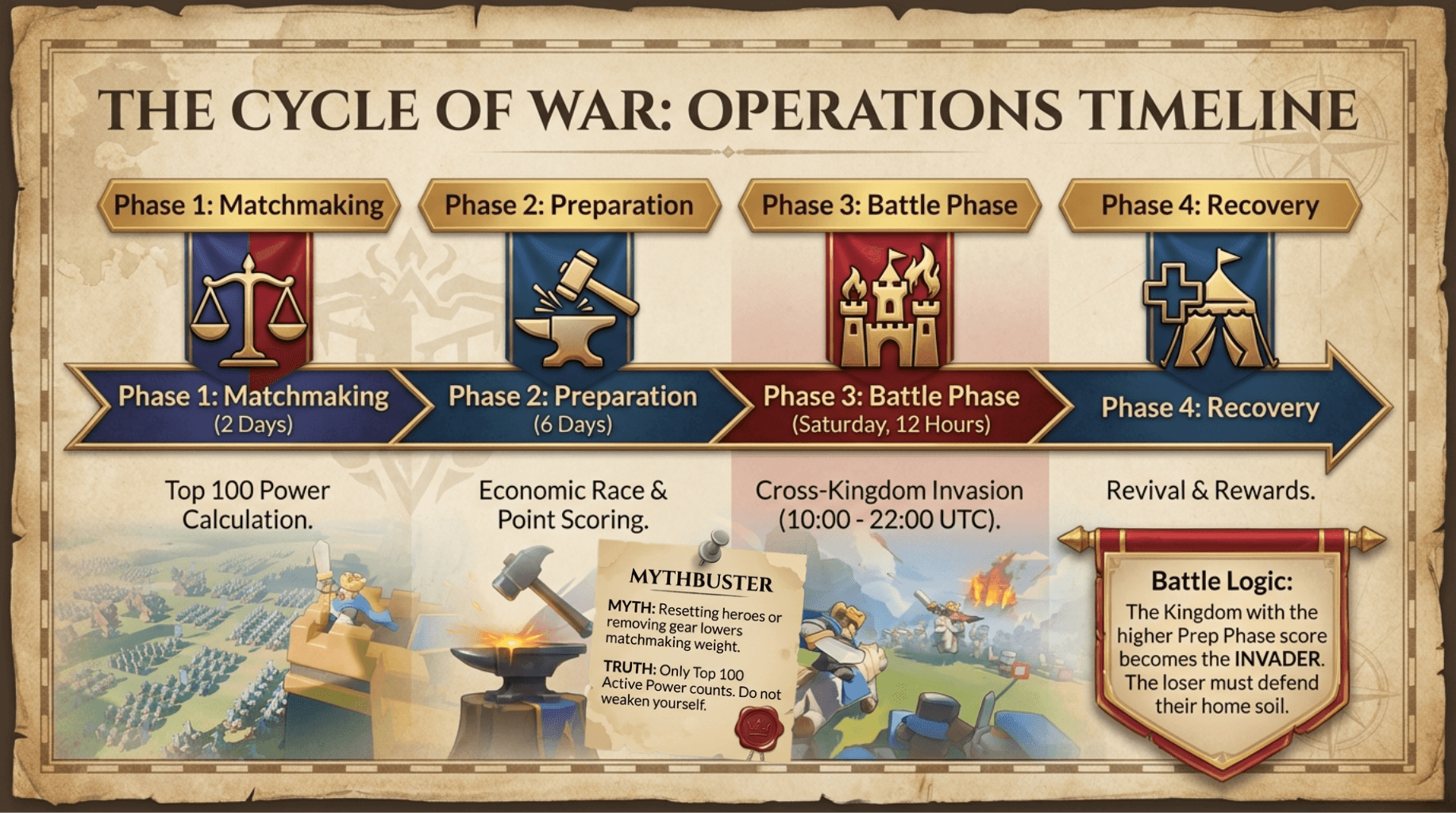
The outcome of a Kingdom of Power event is frequently an exercise in mathematical inevitability, decided during the pairing phase. Matchmaking is governed by "Active Strength," a calculation derived from the troop power of the top 100 active players in a kingdom.

Matchmaking Myths vs. Historical Realities

To maintain a competitive edge, governors must ignore server-room hearsay. The matchmaking engine is sophisticated and prioritizes "Historical Highs":

  • Hero Resets and Gear Removal: These actions have zero impact on your kingdom's score. The system ignores current equipment states in favor of potential power.
  • Troop Disbanding: A catastrophic waste of resources. The algorithm tracks your peak power; deleting troops only weakens your defense without lowering your matchmaking tier.
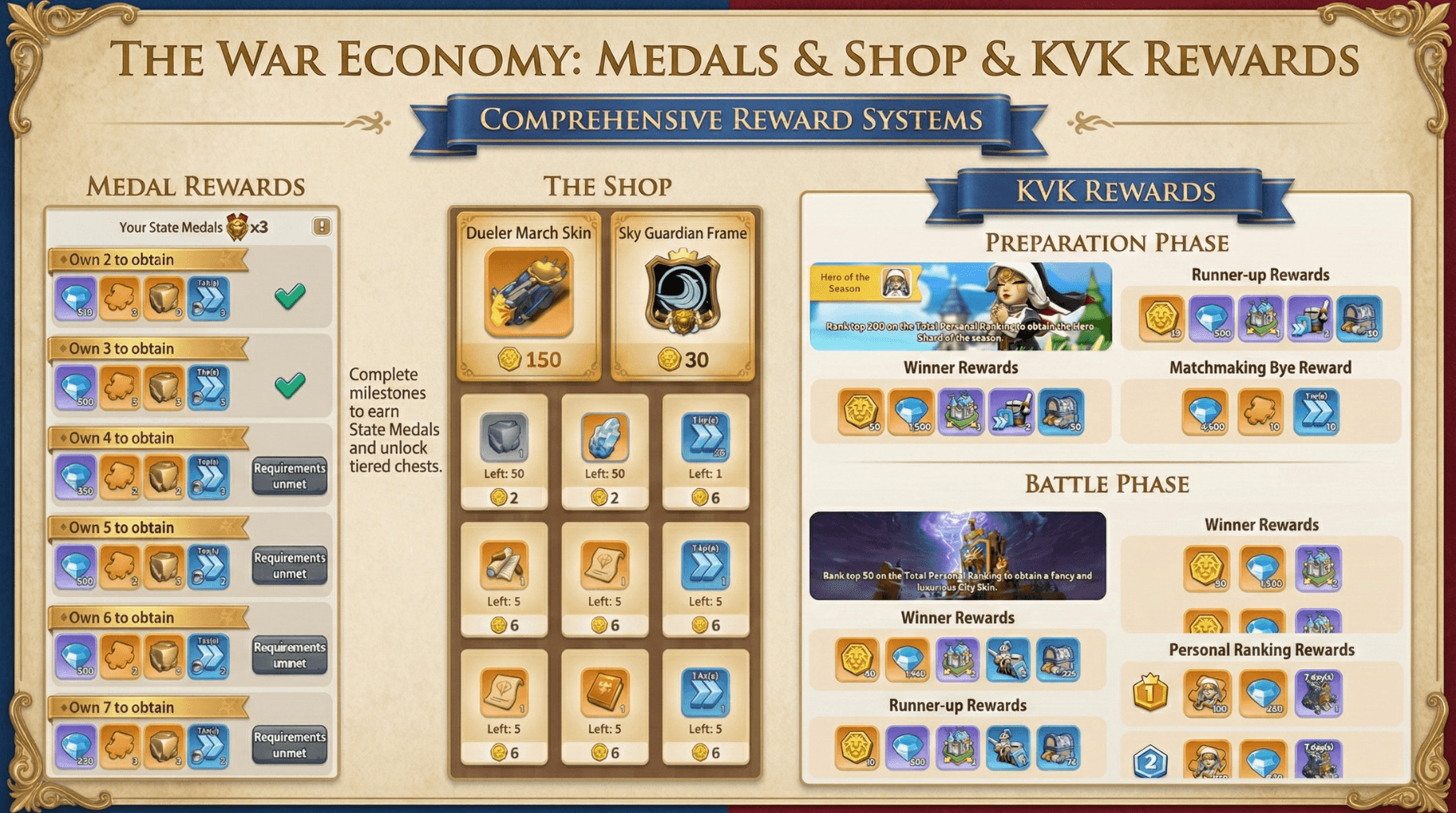
  • The "Bye Week" Fallacy: While a bye week (no matchup) offers safety, it is a strategic net loss. F2P players on "bye" servers lose access to State Medals, Island Wonder Blueprints, and the exclusive Lion of Glory decoration. Avoiding the fight effectively stalls the entire server’s progression.

3. The Truegold Trap: Construction Efficiency

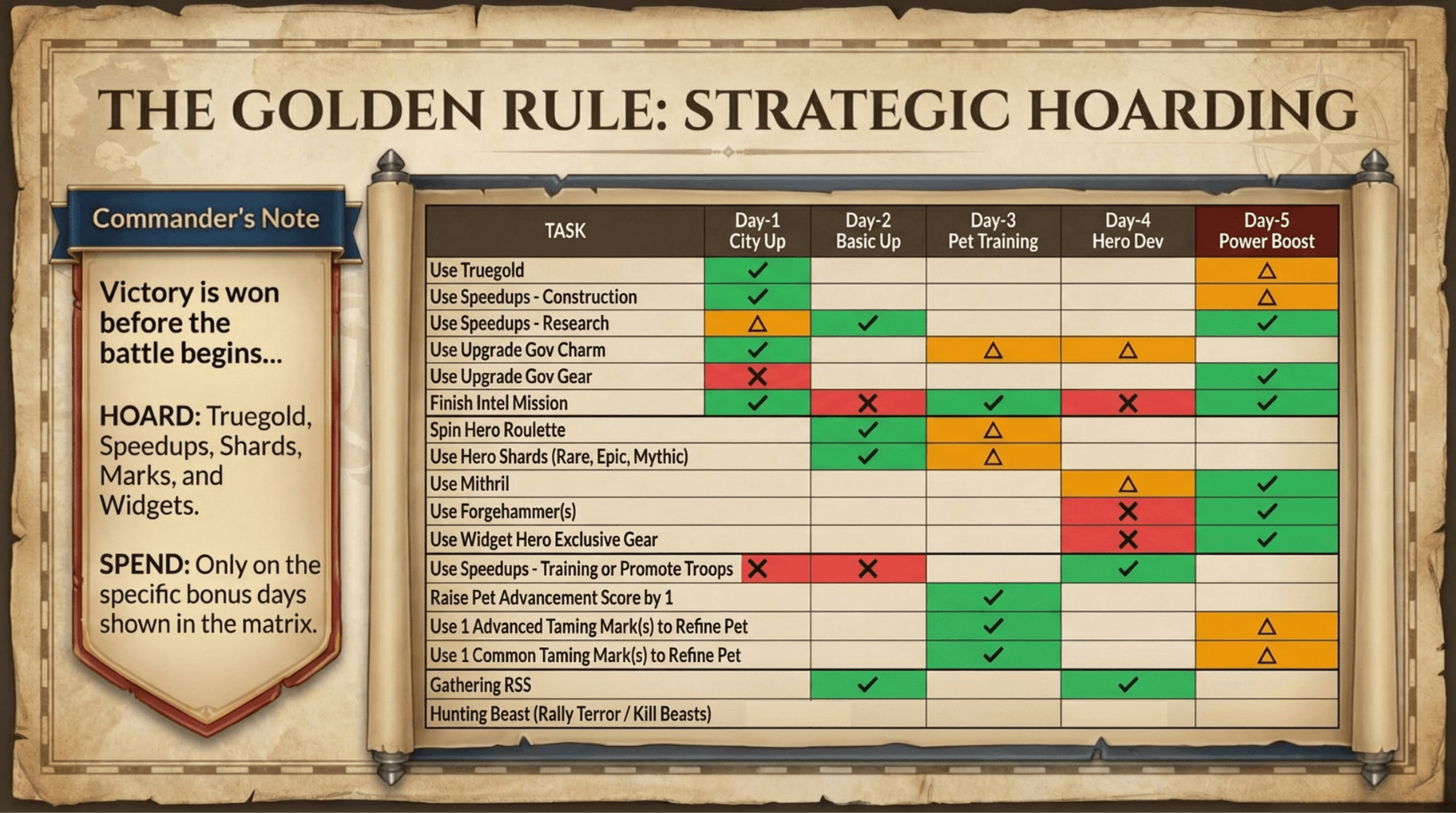
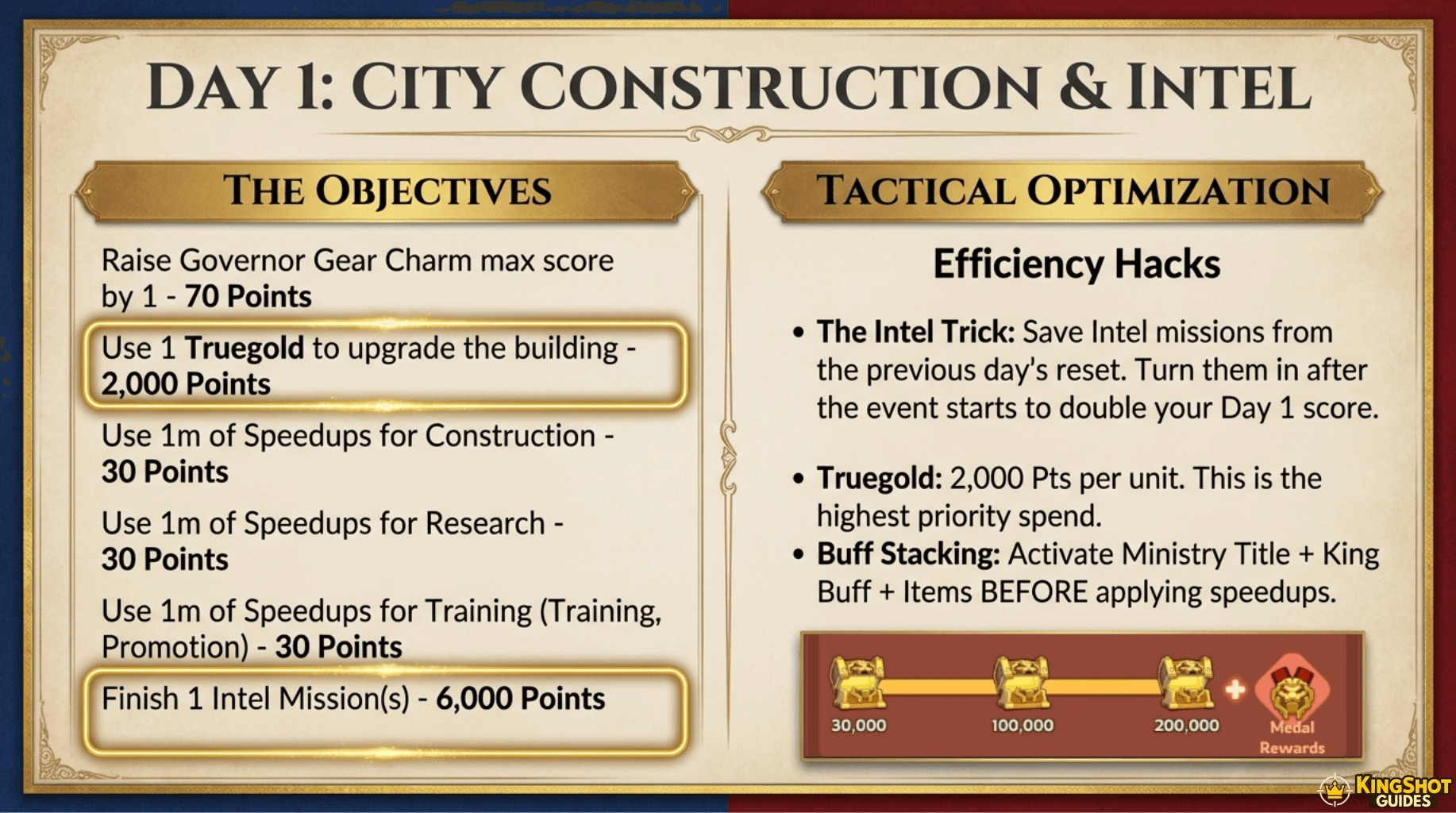
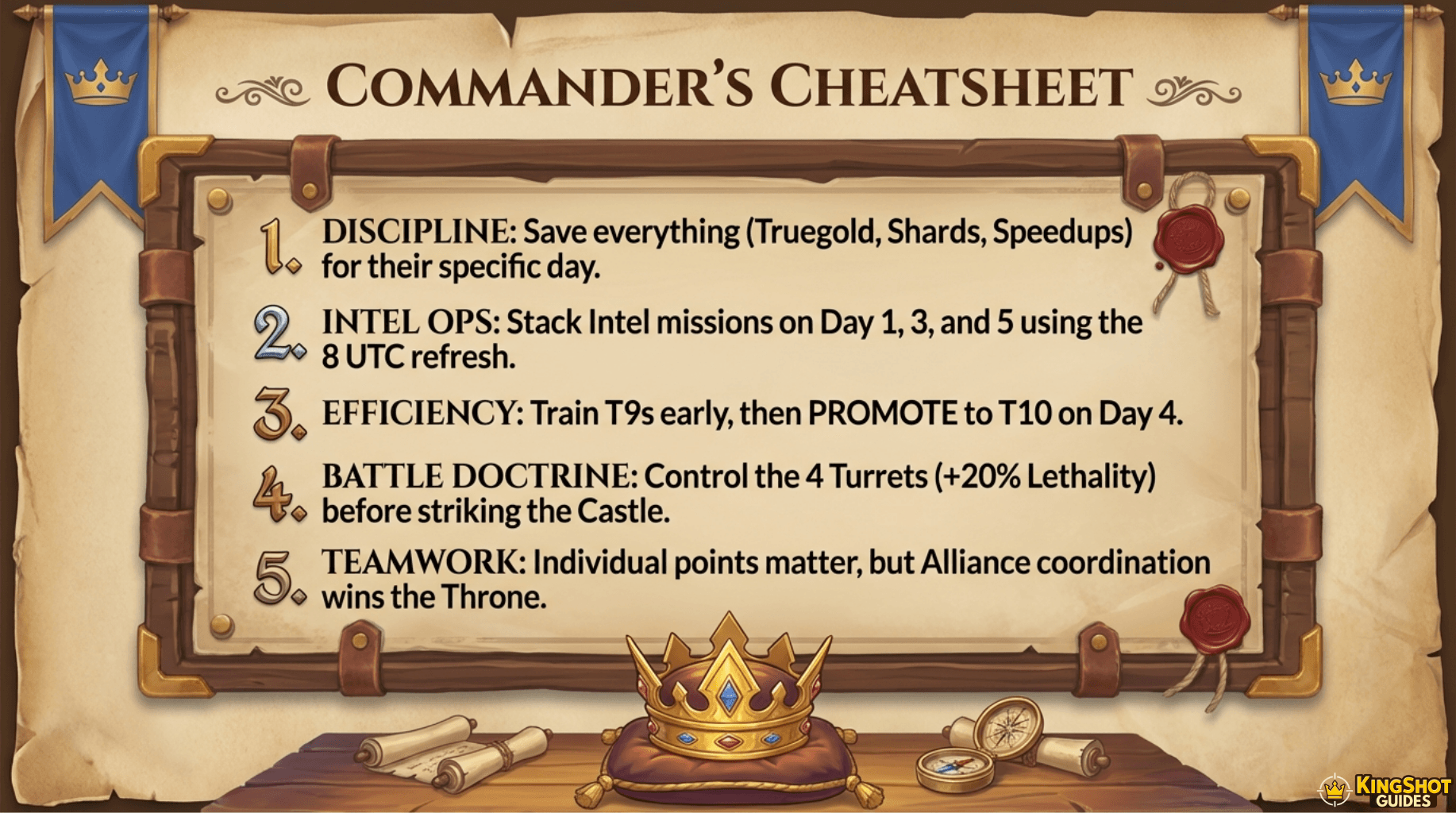
Day 1 of the preparation cycle centers on city development. Truegold, the primary bottleneck of the late game, yields a massive 2,000 points per unit spent. However, the "Truegold Trap" is a psychological pitfall: players often rush builds without a buff window.

The Sovereign Blueprint mandates a strict adherence to the buff schedule:

  • Day 1: Activate the Construction Buff (City Bonus and Chief Minister perks).
  • Tactical Note: Points are awarded when Truegold is spent (at the start of the build). Never cancel a construction in progress; the system only refunds 50% of the Truegold, leading to a permanent deficit in your resource economy.

F2P governors should "hold off" on finishing non-essential battle tech or secondary buildings (Storehouse, Guard Station) until these windows open. This allows you to claim leaderboard positions for development that was already inevitable.

4. The Hero Roulette Gambit: Gems vs. Progression

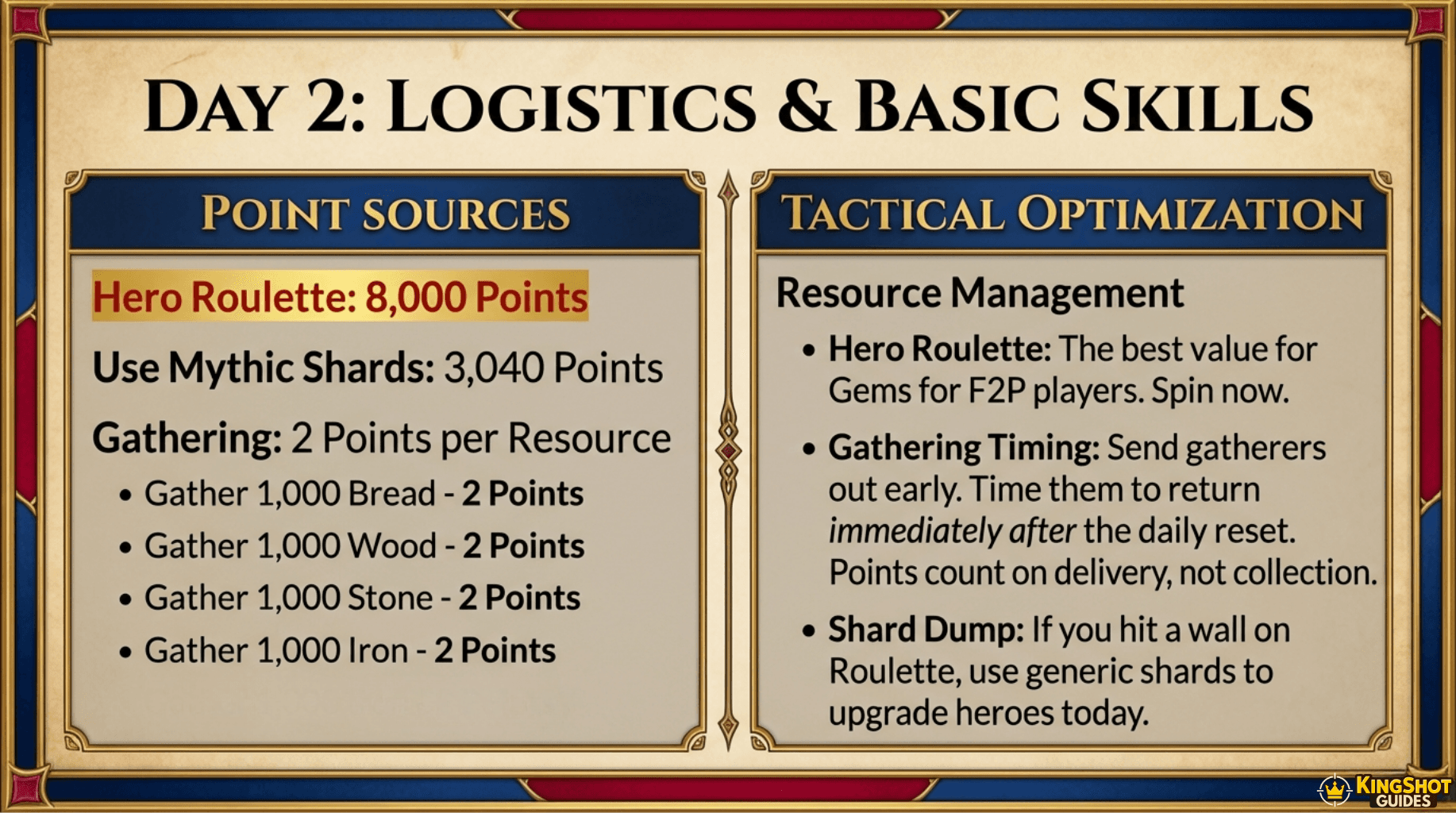
Day 2 introduces "Basic Skill Up" and the Hero Roulette. This is where mathematical discipline meets psychological incentive. Each spin yields 8,000 points, but the true goal is the "breakpoint" rewards at 5, 10, 70, and 120 spins.

As an analyst, I caution against letting the "tail wag the dog." Spending gems past the 120-spin efficiency mark solely for event points is a failure of long-term account management. Unless you are pushing for a Gen-3 cornerstone like Amadeus, save your gems for the next generation.

"If you are a free-to-play player, you need to be strategic with when you upgrade your heroes to maximize points... This will be one advantage you will have in these events versus whales who likely already maxed out all of their heroes." — Strat Game Sloth

5. Pet Advancement: Medallion and Taming Mark Arbitrage

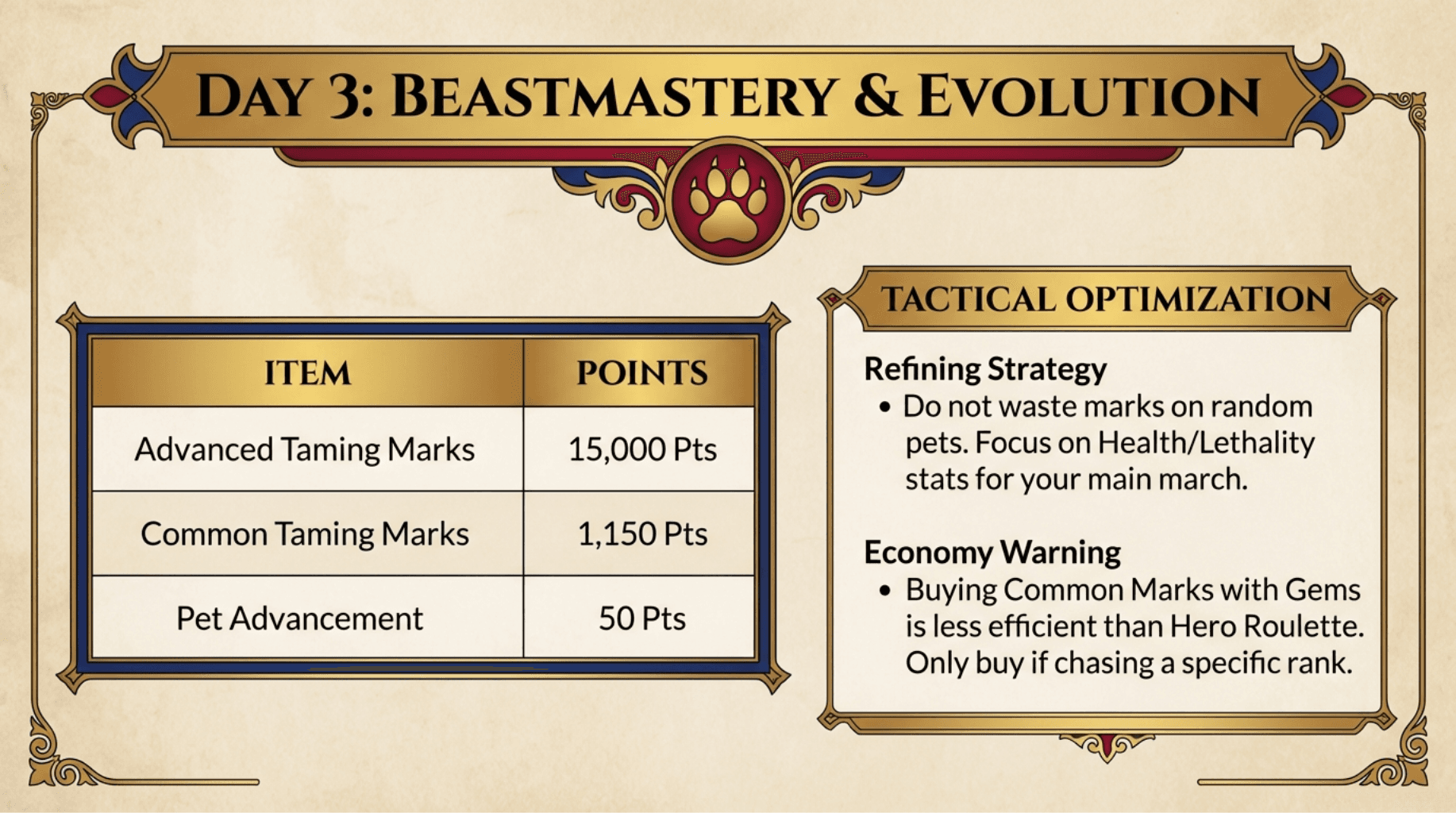
As we transition from hero cultivation to the battlefield, we find "The Soldier vs. the Beast." Day 3 (Pet Training) offers a unique opportunity for point arbitrage.

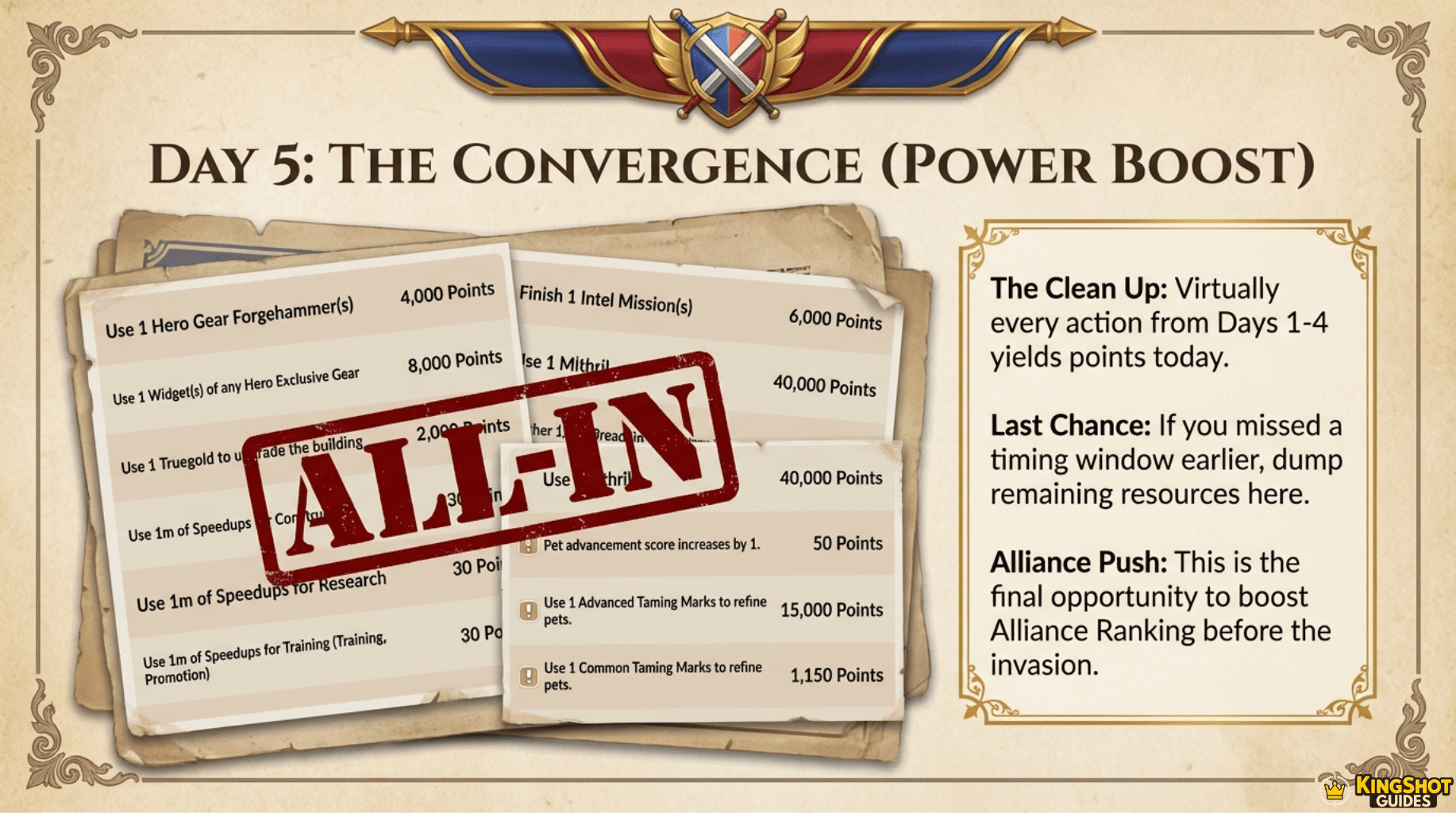
  • Advanced Taming Marks: 15,000 points.
  • Common Taming Marks: 1,150 points.

Because Advanced Marks and Medallions are rare, F2P players should acquire them through the Buccaneer Bounty or Alliance Championship store. For a "rally joiner," these pet materials offer more longevity and lethality than hero gear widgets, which are subject to rapid power creep.

6. Squeezing the Clock: The 300% Capacity Training Trick

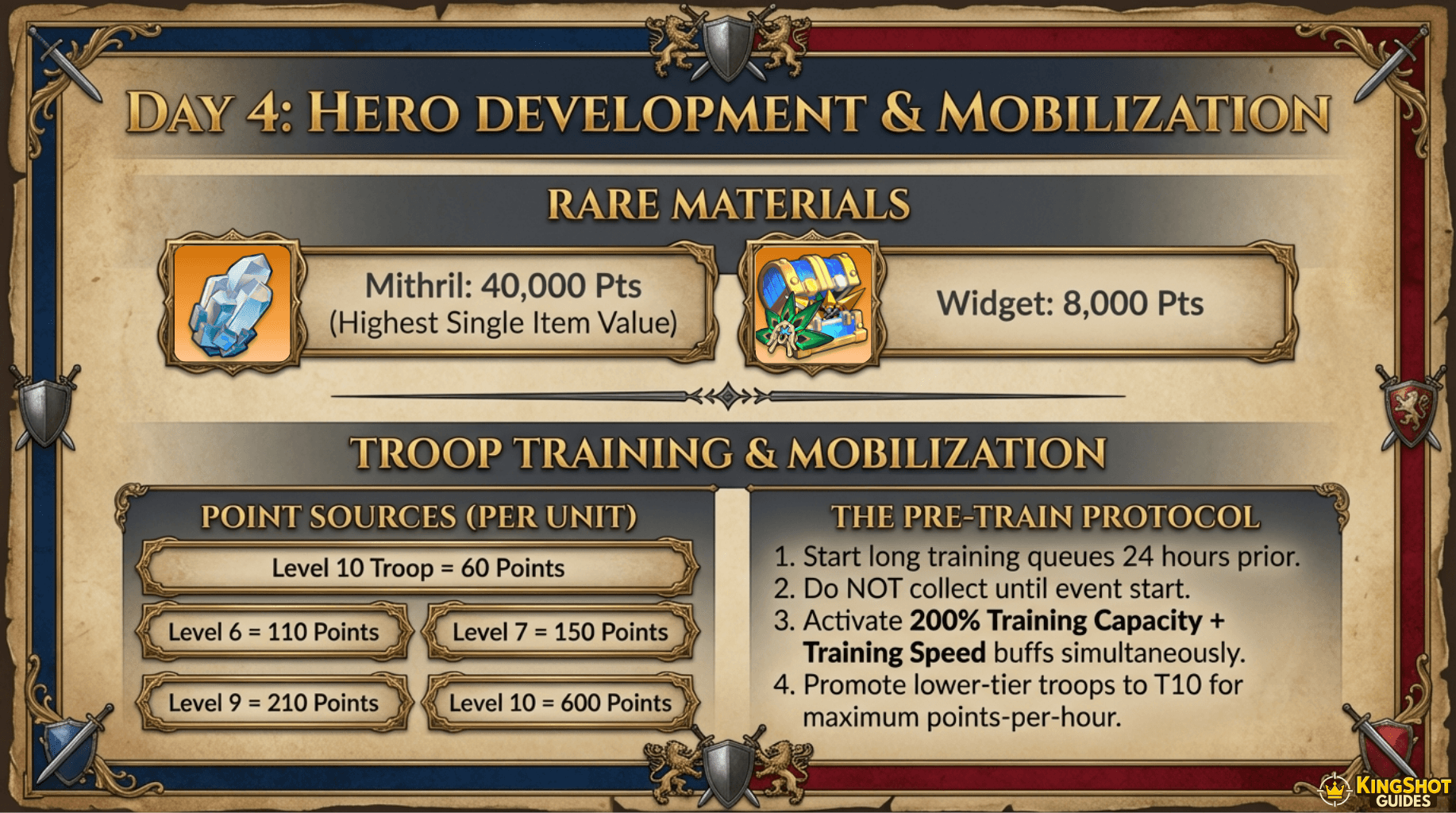
Day 4 (Troop Training) is the most equitable day for the F2P community. Success here is entirely dependent on "Squeezing the Clock."

The Hack: Activate the 200% Training Capacity Bonus exactly 36+ hours before the Day 4 reset. Because an increase of 200% yields 300% of the original total, you can prepare massive "triple batches" across all buildings. Collect them at 0:00 UTC for an instant, massive leaderboard surge.

The Math of Speedup Efficiency

The value of a speedup minute varies wildly depending on the event context. You must distinguish between the two:

  • Kingdom of Power (KoP): A T10 troop yields 60 points.
  • Late-Game HoG: A T10 troop yields 1,960 points per minute of speedup.

"Every time I've done the math for my own situation, the troop promotion from one tier down my max is always a superior method by far of gaining points." — Strat Game Sloth

7. Gear Arbitrage: Navigating the Artisan's Vision Bottleneck

Governor Gear progression is the ultimate gatekeeper of battlefield lethality. As you move into Blue and Purple tiers, Artisan’s Vision becomes the primary bottleneck.

Savvy players utilize "Gear Arbitrage." When a piece of gear requires Artisan's Vision, the costs for Satin and Gilded Thread often plummet. By "running one piece of gear ahead" of the rest, you can balance your material expenditure and avoid being stuck with useless surpluses. Always account for escalating Forgehammer costs; if you lack the materials for the next forge, your points remain locked in your inventory.

8. The Forbidden Area: Mechanics of the Cross-Kingdom Invasion

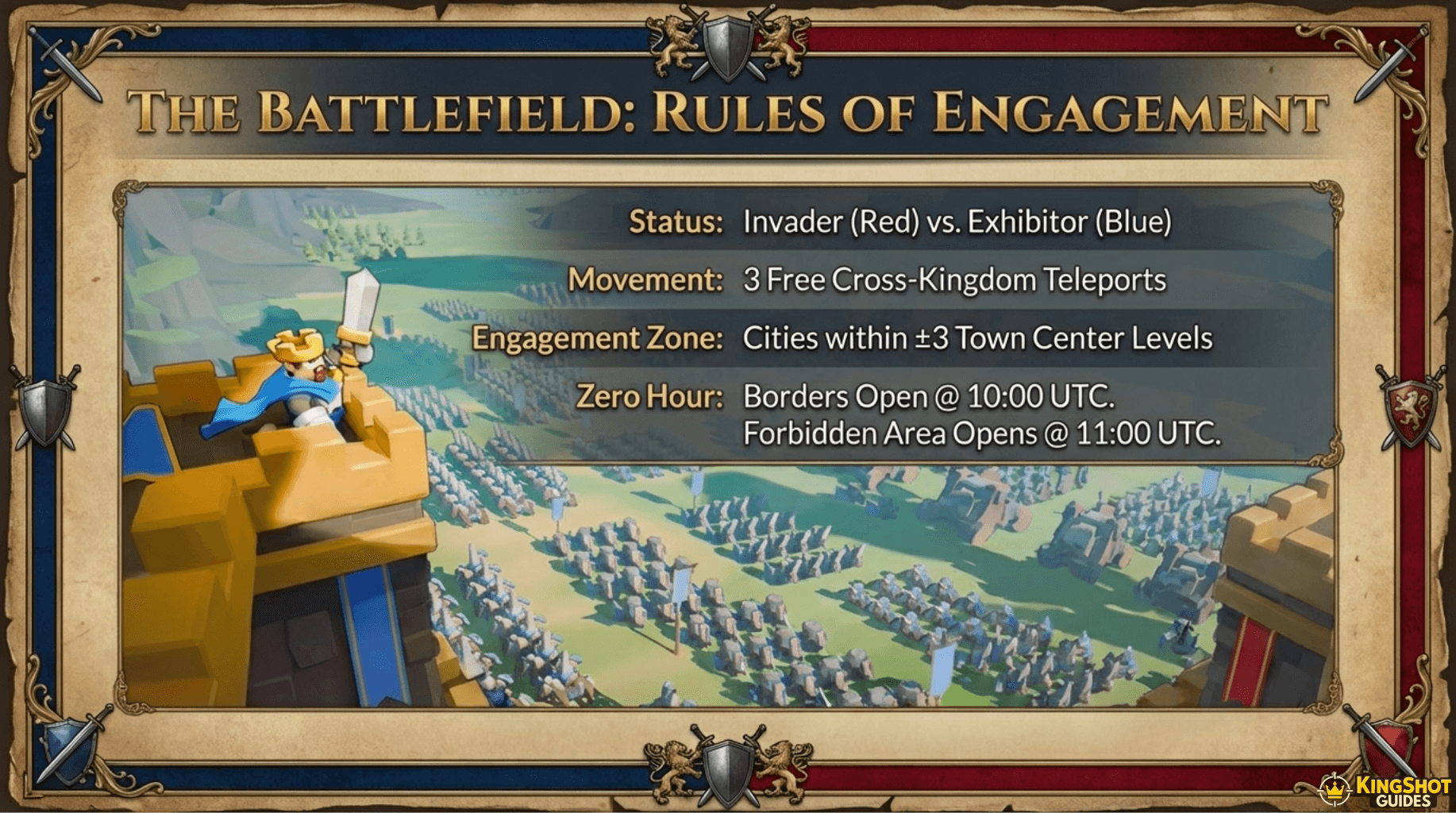
The transition from the Preparation Phase to the Battle Phase (Saturday, 10:00–22:00 UTC) shifts the game from resource management to high-stakes geopolitics. The kingdom that dominated the Prep Phase enters the fight with a decisive advantage: the Healing Speedup and Enlistment Office Capacity buffs.

Rules of the Forbidden Area:

  • Invaders (Red) vs. Exhibitors (Blue): The winner of the Prep Phase invades the loser's map.
  • The ±3 Restriction: You may only target cities within ±3 Town Center levels of your own.
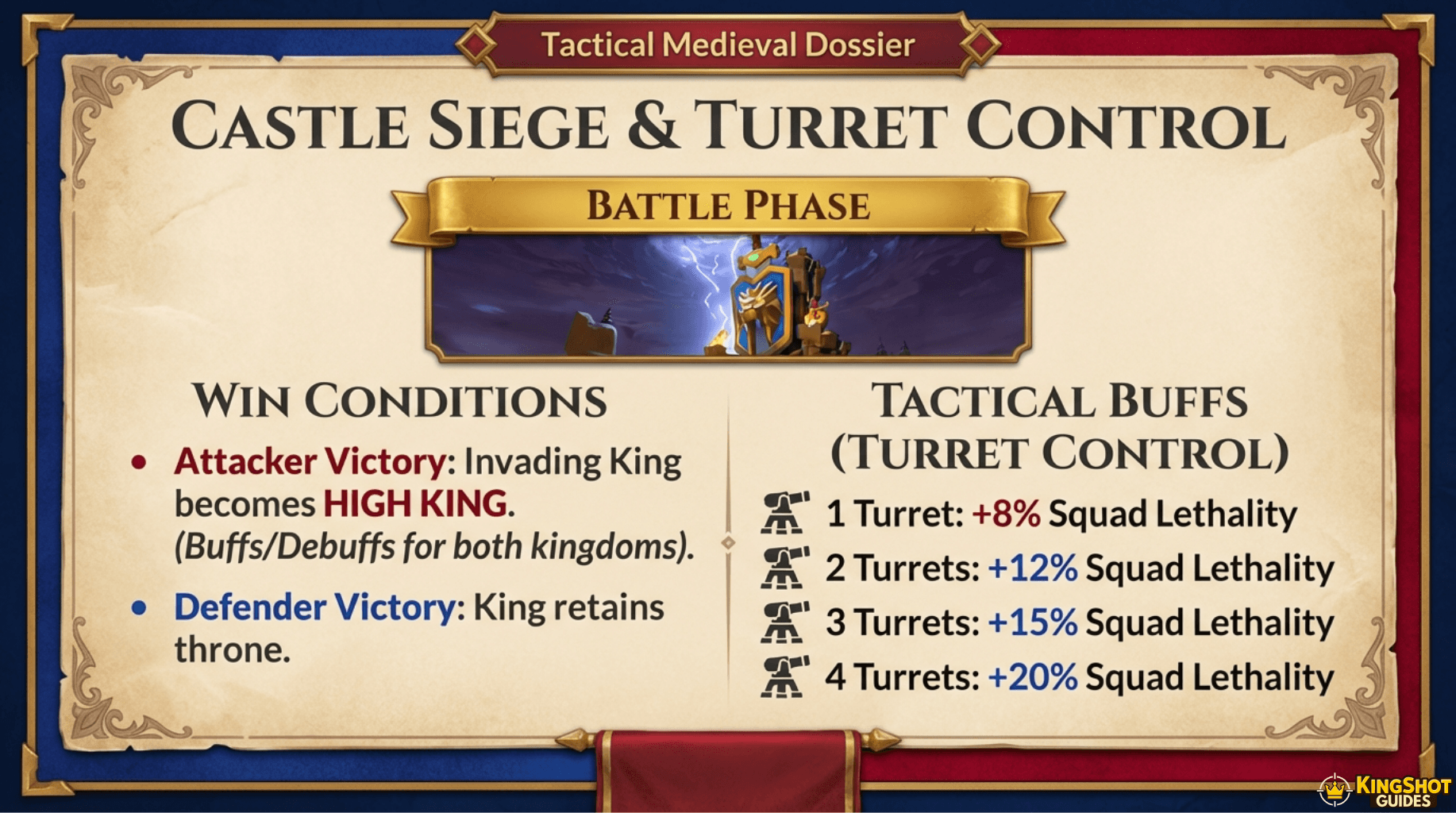
  • The Castle Gambit: The "Forbidden Area" opens at 11:00 UTC. If the Attacker captures the enemy Castle, they appoint a High King.

High King Power Limitations

While the High King can activate buffs and debuffs across both realms, their power is not absolute. They cannot search governors, force exile, or force a ceasefire within the losing kingdom. This creates a "safe" harbor for F2P players who utilize shields and tactical positioning.

9. The Safety Net: Field Triage and Infirmary Management

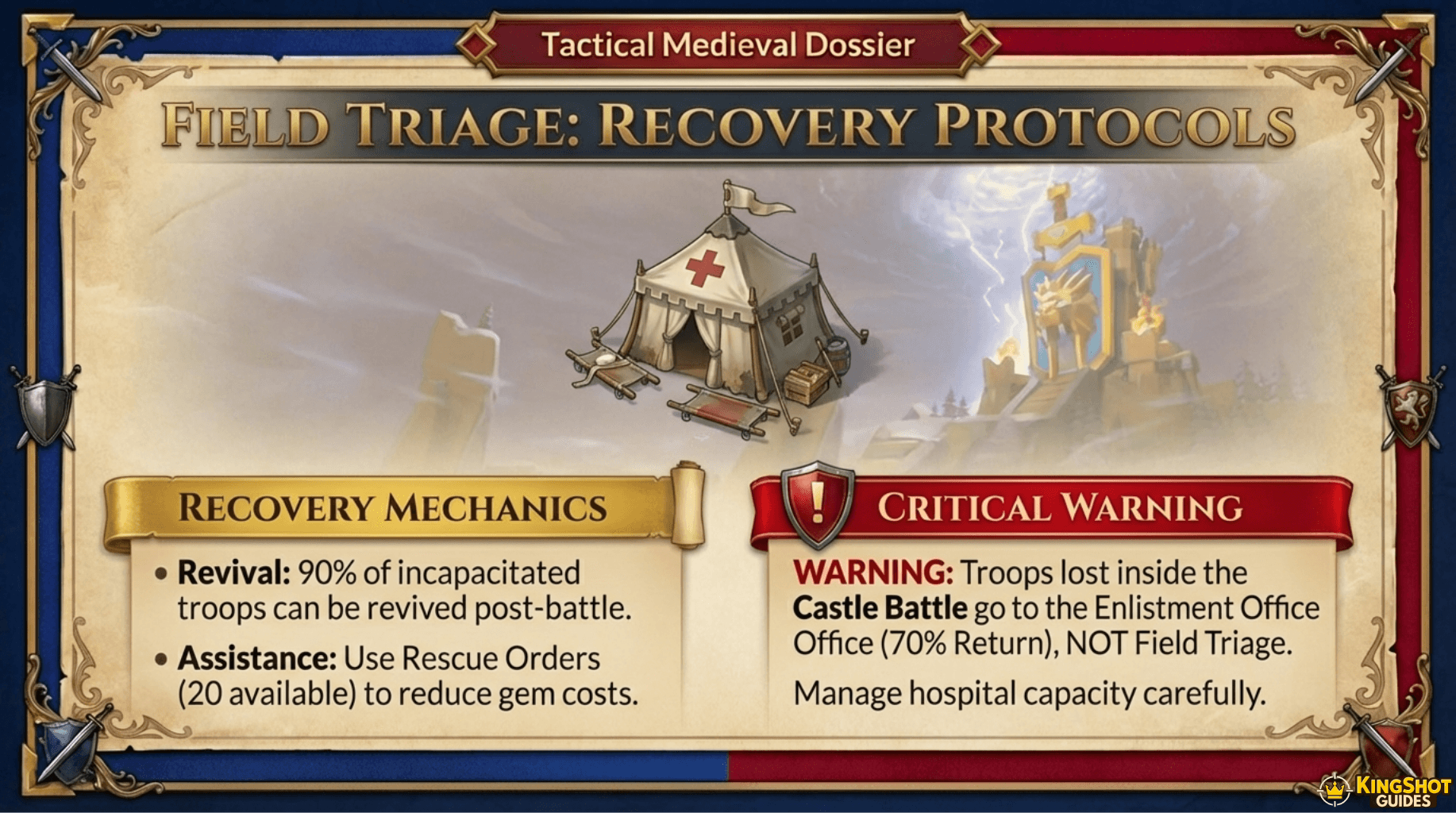
The "post-war" economy is designed to mitigate total account ruin. The Field Triage Phase allows for a 90% recovery of lost troops through 20 Alliance Rescue Orders.

However, there is a critical caveat: Infirmary Management. If your infirmaries overflow during the Castle Battle, the losses become permanent. The Enlistment Office only covers 70% of Castle-specific losses. Maintaining an active alliance is your only economic defense; a single Medical Satchel costs 550 gems, a price that quickly becomes unsustainable without collective "Alliance Helps."

Conclusion: Sovereignty Through Discipline

Ultimately, Kingshot is not a game of who can spend the most, but who can plan with the most mathematical rigor. Sovereignty is the reward for those who treat their resources not as currency, but as pieces on a geopolitical chessboard.

Are you currently hoarding your Truegold for the Day 1 window, or are you leaking value through the 50% refund trap? The next Kingdom of Power is imminent. Activate your 200% capacity bonus now, and ensure your kingdom is the one dictating the terms of the next invasion.